
The Journal · Guidance & Stories
10 Questions Men Ask When Buying an Engagement Ring (But Don’t Always Say Out Loud) 10 Engagement Ring Questions Men Ask
Buying an engagement ring can feel like being dropped into the cockpit of a fighter jet and told, “Off you go!” There is unfamiliar language, a meaningful amount of money at stake and the small matter of choosing something your partner may wear every day for the rest of their life.
I have helped hundreds of men through this decision. Most arrive with some version of the same ten questions, including a few they feel they ought to know already. You do not need to become a diamond expert before you begin. You need to understand your partner, have an idea of a budget range and trust a designer or jeweller who will explain the rest clearly.
I have been designing engagement rings for more than two decades and I am an award-winning British jewellery designer. That sounds rather formal, but the useful part is simpler: I know which questions tend to keep people awake before they make this decision, and I know how to help them answer them.
I remember many occasions when the men approaching me to help me with their dilemma are super anxious and are desperate not to mess it up! I seem to become their wingman in a way and it feels like the trust is created instantly as I take their worries away.
I remember so many occasions when men have approached me feeling genuinely anxious and desperate not to mess it up. I seem to become their wingman in a way. The trust is often there almost instantly, because they realise they do not have to work everything out alone. I can take away the worries, guide them through the unfamiliar parts and help them enjoy what should be an exciting moment.
The short answer: To buy an engagement ring confidently, start with your partner's style rather than a diamond specification. Decide whether the proposal will be a complete surprise, set a budget range and allow time for making and designing if necessary.
1. How do I know which engagement ring style they will like?
Begin with what your partner already chooses, not what an advert tells you an engagement ring should look like.
Look at the jewellery they wear most often. Is it yellow or white metal? Fine and restrained, or bold and noticeable? Do they favour symmetry, clean lines, vintage detail or colour? Their clothes, profession, car, interiors and favourite objects can reveal almost as much as their jewellery.
If you need help, take clear photographs of pieces they wear and share them with the designer. A trusted friend or family member can be useful, but only if they understand your partner's taste and can keep a secret.
A recent client told me that her partner was an architect who loved flashes of colour and was fascinated by the way light plays within structures. That was invaluable. The resulting design had internally polished walls that bounced light intriguingly around the setting, with orange sapphires introducing those flashes of colour. Details that might initially seem unrelated to jewellery can lead directly to the most personal parts of a ring.
The main engagement ring families are straightforward:
|
Style
|
What it feels like
|
An AG route
|
|---|---|---|
|
Solitaire
|
One stone, clarity and restraint
|
|
|
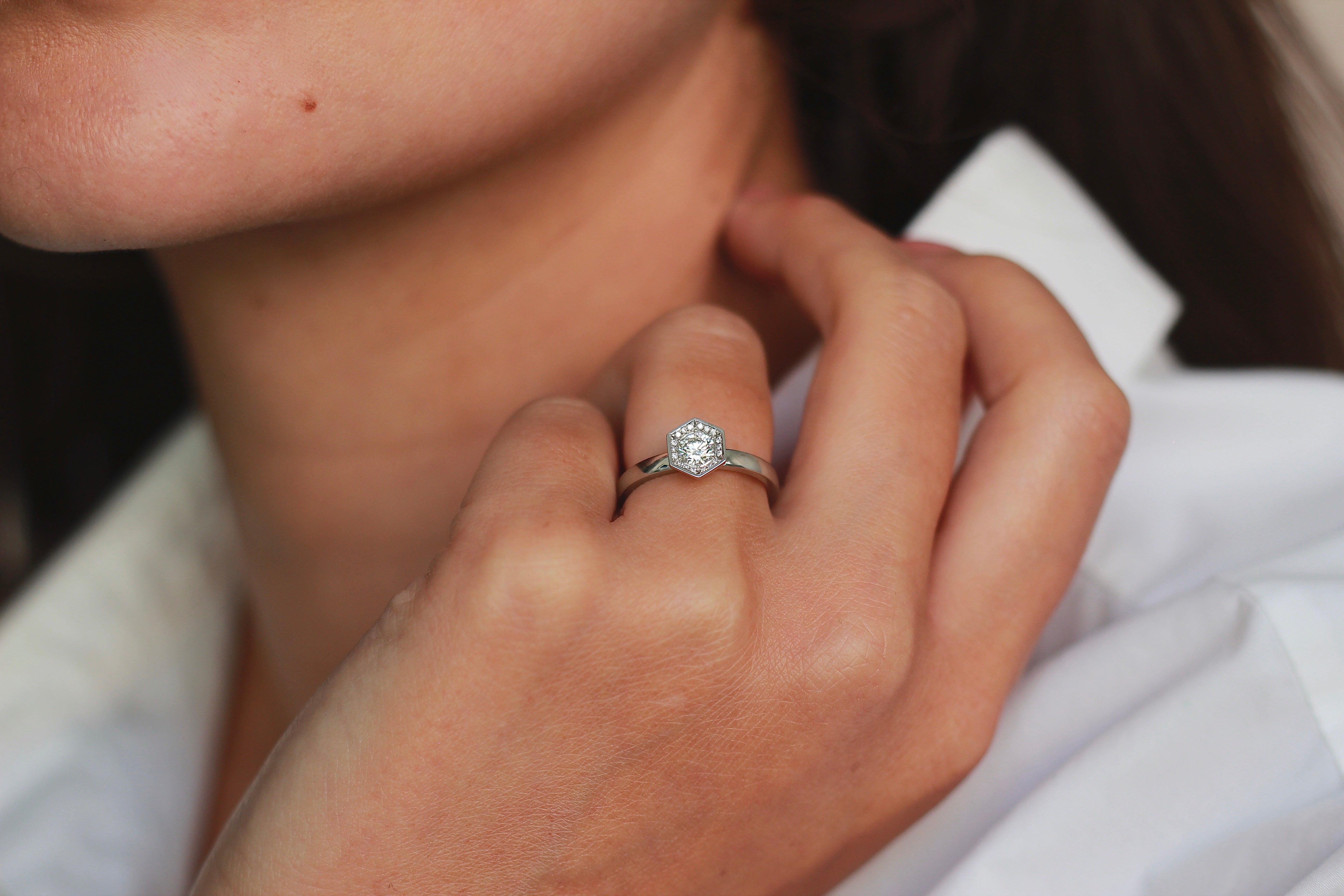
Halo
|
A centre stone framed by smaller diamonds
|
|
|
Coloured stone
|
More individual, with colour at the centre
|
|
|
Two stone
|
Symbolic, asymmetric and distinctive
|
|
|
Three stone
|
Romantic, balanced and symbolic
|
If your partner has ever said, "I would never wear a traditional engagement ring," believe them. Distinctive does not have to mean impractical. It means choosing a design with a point of view.
My engagement rings are designed by me and made in Britain by specialist goldsmiths, setters and polishers. That direct relationship matters. If you ask how a setting works, whether it can be resized or why one stone suits a design better than another, you are getting an answer grounded in how the ring will actually be made.
2. Do I have to choose a diamond?
No. A diamond is a strong choice for an engagement ring because it is hard, durable and brilliant, but it is not the only meaningful option.
Sapphires, rubies and some other gems are also well suited to regular wear and offer extraordinary colour. Spinel can be beautiful too, depending on the stone and setting. Some gemstones require more care, so ask the jeweller whether the stone is appropriate for an everyday ring before falling in love with its colour.
For many couples, a coloured gemstone feels more personal than choosing a diamond by default. The colour might recall a place, a month, a family stone or simply something your partner has always loved.
Explore coloured stone engagement rings.

3. How much should I spend on an engagement ring?
There is no salary rule. Spend an amount that feels significant without putting the start of your engagement under financial strain.
The more useful question is what your budget is buying. Price is affected by the stone, precious metal, weight, complexity of the setting, quality of craftsmanship and whether the design is already resolved or commissioned from the beginning.
Tell the jeweller your comfortable range. A good conversation should help you understand the trade-offs inside that figure, not pressure you to exceed it. You might prioritise a more distinctive design, a particular coloured stone, a larger diamond or exceptionally fine making. Knowing what matters most prevents you from spending money on specifications neither of you values.
For a deeper explanation of where the money goes, read How Much Does an Engagement Ring Cost?.
4. What if I do not know their ring size?
Not knowing the exact size is common, especially when the proposal is a surprise.
The best clue is a ring your partner already wears on the correct finger. If you can borrow, or temporarily steal, one, we can measure it using a ring stick. Do not worry if the only ring available is worn on another finger or the other hand. It will not give us an exact size, but tell us where it is normally worn and we can use it as a practical starting point.
Because many of our clients buy remotely, we can send a ring stick so you can measure one of your partner's rings discreetly at home. Photographs of a ring beside a ruler can also help, although they are less precise.
Ask before buying whether the design can be resized, by how much, how long it would take and whether there is a charge. Some settings are more straightforward to alter than others. It is better to discuss this before the proposal than discover a limitation afterwards.
Use AG's ring size guide for the practical measuring options.
5. Should I choose a natural or lab-grown diamond?
Both are diamonds, but they have different origins, rarity, pricing and secondary markets.
A natural diamond formed underground over an immense period of time. A lab-grown diamond was produced in a controlled environment. They can share the same chemical and physical properties, but their rarity, pricing and resale markets are not the same.
Do not reduce the decision to "ethical versus unethical." Sourcing, energy, labour, certification and traceability all matter, and neither category can be judged responsibly from its label alone. Ask where the stone came from, what independent grading accompanies it and why the jeweller recommends it.
Andrew Geoghegan's collection focuses on natural diamonds and coloured gemstones, but we can also supply lab-grown diamonds. We understand that some clients would prefer a larger diamond within their chosen budget. If origin matters strongly to either of you, settle that question before choosing the design.
6. How long does an engagement ring take to make?
It depends on the route you choose. A ring that is already finished can be much quicker than one made to order, and a commissioned design will usually take longer again.
AG collection pieces are generally made to order in 4 to 6 weeks, although an express service may be possible. Allow additional time for unusual stone sourcing, design changes, engraving, delivery and any sizing adjustment.
If your proposal date is close, do not hide it from the jeweller. Start with the Ships in 5 Days engagement ring collection or discuss whether a temporary proposal ring would let you preserve the moment without rushing the permanent choice.
A fully commissioned ring generally takes over two months and can take longer, depending on the complexity of the design and the stones required. If you have a fixed proposal date, tell us at the beginning so we can advise what is realistically achievable.
7. Should I propose with the ring or choose it together?
There is no correct answer. The right route depends on whether your partner values the surprise more than having a say in a piece they will wear every day.
You have three sensible options:
- Choose the finished ring yourself and make the proposal a complete surprise.
- Agree the style together, then keep the final ring and proposal secret.
- Propose with a gemstone, a temporary or family ring and choose the permanent ring afterwards.
If your partner has strong opinions about jewellery, involving them is not less romantic. It can make the ring more personal. If they love surprises and trust your judgement, choosing it yourself can be wonderful. The important thing is not to turn surprise into guesswork when the clues tell you they want to participate.

8. Do I need to understand carats and the four Cs?
You need a working understanding, not a qualification.
For diamonds, the four Cs are cut, colour, clarity and carat weight. Carat measures weight, not visual beauty. A larger number does not automatically produce a more attractive diamond. Cut quality has an enormous effect on how a diamond handles light, while shape and proportions affect how large it appears on the hand.
Ask to see at least images and videos of the stone rather than buying from a grading report alone. The report is evidence. It is not the visual experience of the diamond.
Also ask how the stone relates to the design. A beautifully proportioned setting can make a modest stone feel completely resolved. A large stone in the wrong setting can feel awkward.
9. What if I do not want a traditional engagement ring?
Good. You can respect the purpose of an engagement ring without choosing the same design as everyone else.
Traditional ring types are useful starting points, not rules. A halo can be architectural rather than decorative. A solitaire can contain detail visible only to the wearer. Two stones can sit in an asymmetric relationship. A coloured gemstone can carry more meaning than a white diamond.
The test is whether the ring feels like your partner and works for the way they live. AG's British engagement rings are designed for people who want something distinctive, properly made and wearable beyond the proposal photographs.

10. How do I start without feeling foolish?
Start with five pieces of information:
- Who the ring is for and how they dress and wear jewellery
- Whether the proposal is a surprise
- The styles or colours they already like
- Your comfortable budget range
- Your intended proposal date
That is enough for a useful first conversation. You do not need to know the correct technical vocabulary. Translating the jargon is part of the jeweller's job.
I have spoken to people planning a proposal a year ahead and people hoping to propose the following week. The calmest process begins with honesty. Tell me what you know, what you do not know and what you are worried about getting wrong. We can work from there.
Three practical routes from here
I want to see the full collection
Browse designer engagement rings by Andrew Geoghegan, including halo, solitaire, diamond and coloured stone designs.
I need a ring quickly
See the Ships in 5 Days collection and check the individual product and delivery details against your proposal date.
I need advice before choosing
Contact Andrew Geoghegan with your budget, timing and any photographs or clues you have. No diamond vocabulary required.
Frequently asked questions
What should I know before buying an engagement ring?
Know your partner's general style, whether they want the proposal to be a surprise, your comfortable budget and your intended date. Then ask the jeweller about stone origin, making time, resizing, returns and aftercare before committing.
Is it safe to buy an engagement ring without knowing the exact size?
It can be, provided you confirm that the particular design can be resized and understand the jeweller's sizing terms before purchase. Borrowing a ring worn on the correct finger gives the best discreet starting point. For remote clients, AG can also send a ring stick or plain sizing rings to help establish the size at home.
How far in advance should I buy an engagement ring?
Ask the jeweller for the current lead time before fixing your plan. AG collection pieces generally take 4 to 6 weeks, while a fully commissioned ring usually takes over two months and may take longer depending on complexity. Allow extra time for stone sourcing, engraving, delivery and resizing.
What questions should I ask the jeweller?
Ask what the price includes, how the stone is graded and sourced, where the ring is made, whether it can be resized, the realistic delivery date, the returns terms and what aftercare is available.