
The Journal · Guidance & Stories
What a Signet Ring Means, and Why I Finally Made One
A signet ring is a ring bearing a personalised mark: historically a seal used to authenticate documents and assert identity, today a symbol of values, memory, or self. The mark it carries is chosen by the wearer. An initial, a family crest, a rune, or a symbol that holds private meaning.
Why I Was Wrong About Signet Rings
Engagement rings, wedding bands, cocktail rings. That is where my work has lived for nearly three decades. Signet rings were not part of my world, and on the rare occasions I paid them any attention, I was not generous. They felt commercial and most of what I saw was nine-carat gold with no real design ambition in it. Not my territory.
That changed slowly, then all at once.
Earlier in my career I had exactly the same attitude toward classic engagement rings. The traditional halo, the classic solitaire did nothing for me. I wanted to do something different and be known for it. Then I designed the Cannelé, a halo ring with unmistakable classic sensibilities, and I had to sit with the classics properly to understand what I was working in. The genius was right there in the proportions, the practicality, the durability. I had dismissed something I had never fully looked at.
The same thing happened with signet rings. And the reason it happened was archaeology.
 15th century gold signet rings - origin France
What Is a Signet Ring?
A signet ring carries a signet face, and it traditionally bears a mark unique to its owner. That mark was once pressed into wax to seal letters and authorise documents, in the same way a modern signature does. The word "signet" shares its root with "sign" and "signal": at its most literal, it is a mark of who you are.
For much of their history, signet rings were instruments of power. An unsealed document was unverified. A ring in the wrong hands was a risk. Ownership of a signet ring was, in the most practical sense, proof of identity.
That practicality is long gone and what remains is the idea behind it.
Where Signet Rings Began
The oldest signet rings trace back to ancient Egypt, where pharaohs and officials used scarab seals pressed into clay to mark ownership and authority. The Romans wore iron signets as rank insignia, later adopting gold as wealth permitted. Medieval Europe made the signet ring central to aristocratic and ecclesiastical life. Bishops, lords, and kings each carried a seal that stood for them when they could not be present.
In Britain, the signet ring entered everyday culture through the landed gentry and eventually the merchant classes. A family crest on a gold band identified both the wearer's bloodline and their standing. The mark was inherited as much as worn.
What made the signet ring meaningful was not the metal. It was the idea that a single small object could carry someone's name, their family, their authority: compressed into a mark small enough to fit on a finger.
How the Meaning Has Shifted
The seal function is obsolete. But the impulse behind it, to mark something as yours, to carry a symbol that holds meaning, has not disappeared. It has merely changed direction.
A signet ring once declared inherited identity. People now choose one to declare a chosen identity. The crest has given way to the initial. The dynasty to the individual. The inherited mark to the personal one.
But the story is not quite that linear. There is a chapter between the seal and the self. In the Renaissance, wealthy collectors wore rings set with carved portraits of Roman emperors - not to seal documents, but to declare allegiance. The ring said: this is who I admire, this is the tradition I place myself inside. Borrowed identity, worn as devotion. It is an impulse that has never really left us.
 16th century gold and enamel with intaglio emperor's head in aquamarine.
This shift has accelerated as fine jewellery moved away from the engagement ring as its sole reference point. Rings bought for oneself, worn on the right hand, given to mark something that has no existing category: these opened space for the signet ring to mean something new.
A signet ring worn today may still feature a family coat of arms, or carry the wearer's own initials but as we see in the section below, there are more stylised rings showing stories, motifs with engraving and gemstones alike. Perhaps the biggest shift though is that it is the choice of men and women now as opposed to just men.
Why People Choose a Signet Ring Now
The people who come to a signet ring today are not, as a rule, looking for something just decorative. They want something that means something. A ring that carries a story, a value, a memory. Something that earns its place.
The questions they ask reveal this:
- What should I have engraved?
- What mark would I actually want on my hand for the next forty years?
- Is there something this ring can carry that my other jewellery cannot?
Those are not questions about aesthetics. There are questions about permanence and intention. The signet ring's appeal right now is that it demands an answer to them. It is a ring with a purpose, not just a presence.
The Anglo-Saxon Find That Changed Everything
In Lincolnshire in 2025, I was metal detecting with my son Arthur when we unearthed a piece of Anglo-Saxon gold from the ground. It was small, detailed, and extraordinary.
 Anglo-Saxon gold find
What followed was a deep entry into a new world: visits to the British Museum's private study room, time spent with objects that had not been handled by many people in centuries, and an encounter with the Seax of Beagnoth, the ninth-century blade with Anglo-Saxon runes carved along its edge.
Those hours with objects made by people whose names we do not know, for purposes we can only guess at, objects that survived more than a thousand years and still held their form: that changed the direction of my work.
The Treowth collection began there. And Wunden, the second piece in that collection, carries that history in its design.
The word wunden appears in Beowulf. It means twisted, woven, braided, and refers to precious metals worked by hand into a form that held both beauty and intention. Not decorative language. A description of something made with skill and purpose, something meant to last.
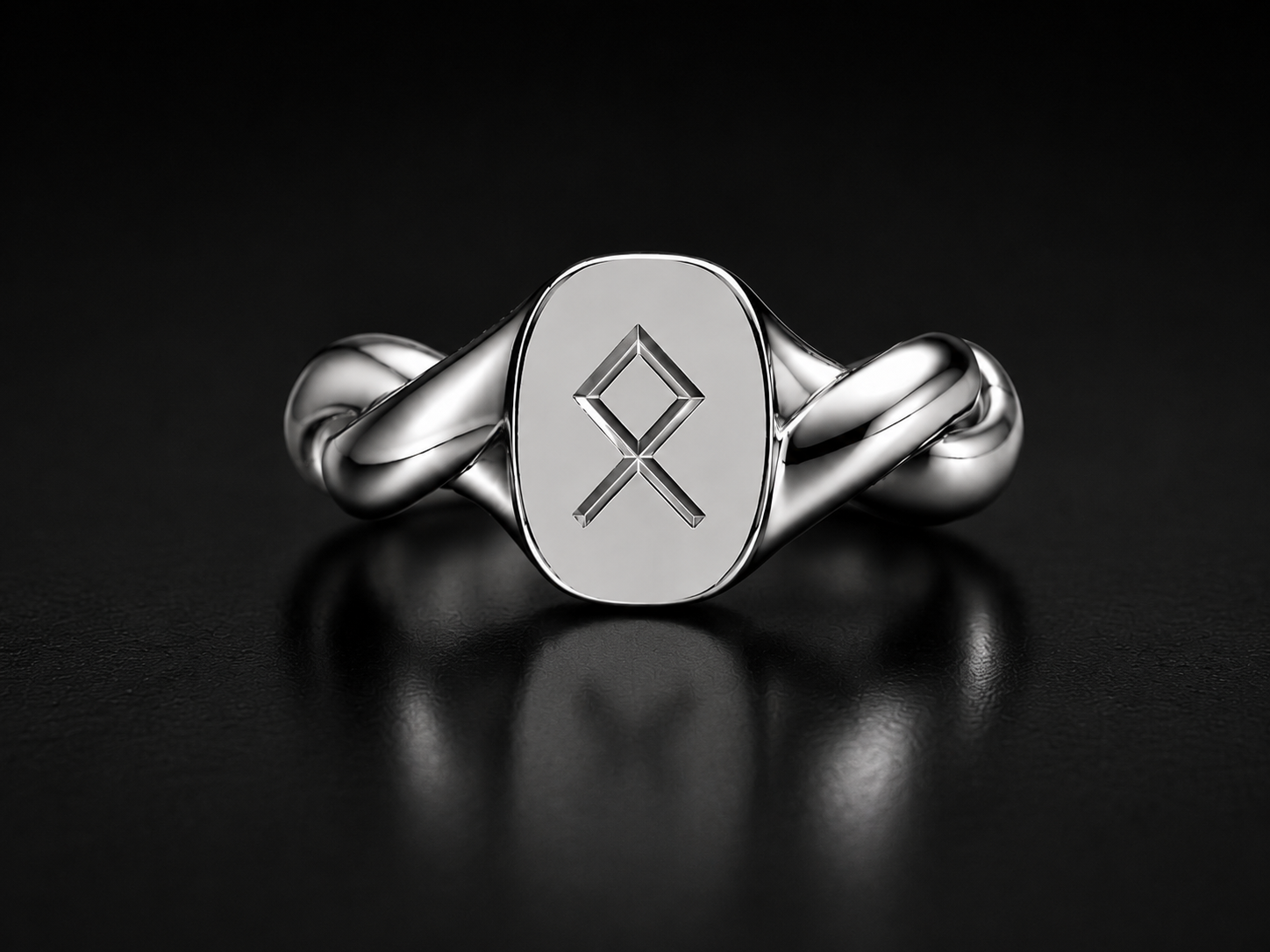
That word, and the metalwork tradition behind it, became the reference point for a ring built on two twisted strands of silver, rising and flowing seamlessly into a signet face. A ring made to carry a mark chosen by the person who wears it.
Wunden: Movement and Stillness
The signet face matters. That is where the mark goes. But the band, look at it and you notice it is in motion. The silver tapering strands, twisting around each other, spiralling up into the signet face. There is tension in it. The strands pull and twist against each other as they rise. They flow into the signet face, which is completely still. A flat, cushion-shaped surface. A blank canvas, yours to mark or leave unmarked.
 Side profile of the silver Wunden signet ring
The ring is simultaneously moving and still. The band carries all that energy and delivers you somewhere quiet. That contrast came directly from the Anglo-Saxon find, from further study into the metalwork of that period. The twist is not an aesthetic choice borrowed from history for effect. The twist is the point.
Wunden comes in two profiles: a finer form for slender fingers, and a broader, heavier form for those who want more presence on the hand. The twists are substantial in either. The design does not shy away from itself. Legacy Rune being perfected before the launch
The Mark It Carries
Wunden's signet face can hold a mark in one of three forms:
The first is a Rune from the Anglo-Saxon Futhorc, Old English Runic symbols each with with a specific meaning. The Runes are hand-engraved into the signet face.
| Rune | Meaning |
|---|---|
| ᚹ | Joy |
| ᚾ | Endurance |
| ᛉ | Protection |
| ᚱ | Journey |
| ᛏ | Courage |
| ᛟ | Legacy |
The second option is a classic initial or monogram, hand-engraved in a choice of styles.
The third is a blank face: for the wearer who wants the form without the mark, or who will decide later.
The Secret Stone Underneath
There is one detail most people do not expect.
Beneath the signet face, hidden, sits a stone. A diamond, a ruby, a blue or pink sapphire, or a tsavorite. The choice is yours, and other stones can be requested. A favourite colour, a stone you feel something toward. It is not a decision that needs to be explained to anyone.
The stone rests near the skin. Nobody sees it unless you choose to show it. The ring does not announce it, but you know it is there.
This is one of the things I find most interesting about jewellery: it does not have to be about what other people see. A stone chosen privately, worn daily, known only to the wearer. Or shared with one person. A kind of inscription only you can read.
It makes Wunden a gift worth thinking about, for yourself or for another.
Why Silver
Wunden is made primarily in silver and that choice was deliberate. Firstly it has been 20 years since silver has graced my workshops so it seemed fitting to launch the piece with the return of this metal increasing rapidly in popularity and value.
Also the braided strands that give the ring its character need depth and profile to read properly. The same design in 18ct gold carries a significantly higher material cost. Silver allows the ring to be exactly what it should be: substantial, present, not reduced to a lighter profile to keep costs down. Wunden is available in gold and platinum, but silver is where the design is fully itself.
In the End, It Is Yours
The find in that Lincolnshire field was someone's story. We do not know whose. We know they were there, that they made something, that it mattered enough to be worked in gold and carried. That object survived more than a thousand years.
Wunden is not a replica of that object. It is a response to what that object says: that a ring can hold a story, that the mark on it belongs to one person, that the form is worth making well.
The signet face on Wunden is blank until you decide what goes on it. Your rune. Your initial. Nothing, for now. And underneath, if you want it, a stone close to your skin that nobody else needs to know about.
Your story held by the ring.
Frequently Asked Questions
What does a signet ring mean?
A signet ring carries an engraved mark: historically a seal used to authenticate documents and assert identity. Today, the meaning is personal. The wearer chooses their own mark, whether an initial, a symbol, a story or even a traditional crest. The ring is a statement of identity or connection to something close to the owners heart.
Where did signet rings originate?
Signet rings trace their origins to ancient Egypt and Rome, where engraved seals were pressed into clay or wax to mark ownership and authority. In Britain, they became closely associated with the aristocracy and merchant classes through the medieval period, carrying family crests as proof of identity and lineage.
What finger does a signet ring go on?
Traditionally, a signet ring is worn on the little finger of the non-dominant hand. British convention often places it on the left pinky. There is no rule now. Right hand, index finger, wherever it sits best. The choice belongs to the wearer.
What should I engrave on a signet ring?
The most enduring choices are initials, a meaningful symbol, or a mark with personal significance. The question worth sitting with: what would you want on your hand in forty years? A mark chosen for its meaning will outlast one chosen for its appearance.
What does "Wunden" mean?
Wunden is drawn from the Old English word wunden, used in the poem Beowulf to describe twisted or braided precious metals worked by hand. It is the name of the second piece in Andrew Geoghegan's Treowth collection of Anglo-Saxon-inspired fine jewellery.
Why is Wunden made primarily in silver?
The twisted strands that define Wunden need depth and profile to read as a design. The same ring in 18ct gold carries a significantly higher material cost. Silver allows the ring to be exactly what it should be: full presence, no reduction in profile, at a price that does not ask for compromise. Wunden is available in gold and platinum, but silver is its natural home.